West Temaenian Littoral
The DispossessedWest Temaenian Littoral is the western coastal region associated with Anarres’s great afforestation undertaking, a two-year effort that employed nearly 18,000 people during the fifteenth decad of the Settlement. Its significance lies in the contrast between a narrow, habitable strip along the sea and the vast inland Dust: the project sought not merely to use the region, but to restore a landscape transformed by long drought and to make ecological repair a form of shared work.
Setting and Ecological History
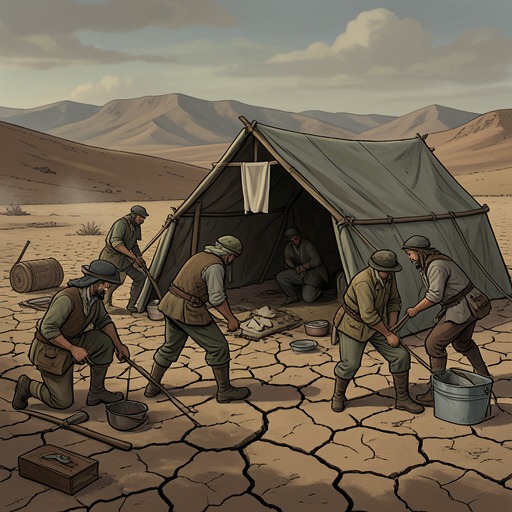
The southeastern beaches and coastal belt supported fishing and farming communities, but arable land extended only a short distance inland. Southwestward, across the plains, the Dust was largely uninhabited apart from isolated mining towns. The contrast made the littoral a boundary between productive settlement and a damaged interior, rather than an unlimited agricultural frontier. The Dust had once been an immense holum forest, dominated by the plant genus common across Anarres. A hotter, drier climate and millennia of drought killed the trees and desiccated the soil. Wind lifted the resulting fine grey dust into barren hills. The afforestation effort therefore addressed a landscape shaped by slow environmental change, not a temporary failure of cultivation.
The Afforestation Project
The Anarresti hoped to restore the Dust’s fertility by replanting forest. During the project’s second year, planting crews received thousands of tiny trees raised in the Green Mountains, where rainfall could reach forty inches a year. The seedlings were transported from Northeast and planted in the dry ground, linking a wetter growing region to a restoration site whose own ecology had been radically altered. When the fifty crews working that year finished, they looked back from their departing flatbed trucks and saw a faint green veil on the pale desert terraces. The first visible result was slight against the scale of the damaged land, but the crews cheered and sang between the trucks. For Shevek, the new growth recalled the image “She brings the green leaf from the stone.” The scene presents recovery as collective labor whose evidence is initially delicate: a beginning, not a completed return to forest.
Anarres, Scarcity, and Shared Systems
The project’s ambition sits within a society dependent on limited ecological resources and coordinated work. Later, during a severe drought, an early, cold, dry winter intensified hardship in Abbenay. Water for bathing was strictly rationed, while water was directed to sustaining plants; food and clothing for Anarres’s twenty million inhabitants depended on holum leaf, seed, fiber, and root. The contrast between the planting project’s long horizon and the emergency’s immediate demands makes clear that restoration did not remove the underlying vulnerability to drought. That vulnerability also ran through transport and distribution. After a year of drought, the transport network could not meet the extraordinary demand to move food and emergency workers. A train carrying Shevek was delayed because provision trains took priority, then stopped for twenty hours after a dispatching error and a wreck. In the mill town where it halted, there was no surplus food: feeding the train’s 450 passengers could leave the town’s 160 residents without food. The town gave the passengers nothing, and they fasted for sixty hours. The episode exposes the difference between a shared ethic and the material conditions that make sharing possible; under severe scarcity, access to food and the decisions governing its distribution became an ethical and political crisis.
Meaning and Narrative Role
West Temaenian Littoral gathers two scales of the book’s environmental concerns. The Dust’s transformation records the cumulative effects of climatic drying, while the planting crews’ work proposes a deliberate, cooperative response. The project’s faint green trace gives physical form to the possibility of reversing damage, but the later drought and transport shortages prevent restoration from becoming a simple story of environmental mastery. Anarres’s landscape demands continuing labor, and its social ideals are tested not only by what people can plant, but by how they organize scarce water, food, and movement.